
What Credit Score Do You Need to Buy a House?
By Porsha O’Reilly, Senior Editor, Credit Strategy. 5+ years in credit optimization and mortgage readiness, 1,000+ clients served.
Last reviewed: 2026. Credit-score and rate figures change; this guide is reviewed at least once a year.
You’ve been watching your score climb toward the mid-600s. And you keep coming back to the same worry: is that actually enough to buy a house, or are you still short?
It’s one of the most common questions we hear from buyers a few months out. The honest answer is more encouraging than most people expect.
It starts with a fact that trips almost everyone up: the number on your phone probably isn’t the number a lender will use.
It comes down to two things: your loan, and the score a lender actually pulls.
The short answer
There’s no single credit score to buy a house. The minimum depends on the loan.
As of 2026, FHA loans start at a 580 score with 3.5% down (or 500 with 10% down). Conventional loans work best with a credit score of 620 or higher. VA and USDA loans have no minimum score, though lenders that fund them usually want about 620 or 640.
Most buyers in the mid-600s already qualify for at least one loan program.

| Loan type | Lowest score that can work | What most lenders want | Good to know |
|---|---|---|---|
| FHA | 580 for 3.5% down; 500 with 10% down | 580 to 620 | Most flexible on credit, and often the lowest monthly cost from 580 to 679 |
| Conventional | No set score in the automated system since Nov 16, 2025; 620 if a person reviews the file | 620 | 620 is still the real-world floor at most lenders |
| VA | No score set by the VA | About 620 | No monthly mortgage insurance; the minimum is set by the lender |
| USDA | No score set by the USDA | About 640 | 640 is the cutoff for USDA’s automated approval, not a rule |
While many buyers qualify with a score of 620, that score isn’t always the one that gets the best interest rate. Even a small bump could save thousands over the life of the loan, and the score that decides your rate may not be the one on your phone.
Want to know where you stand today? Start with a personalized mortgage credit analysis.
One important update, because most articles are out of date. On November 16, 2025, Fannie Mae removed its old 620 minimum score for conventional loans that run through its automated system, and Freddie Mac made a similar move.
That doesn’t mean the number stopped mattering. A conventional loan reviewed by a person still requires a 620; most lenders keep their own 620 minimum, and your score still determines your interest rate.
The score lenders use isn’t the one in your credit or banking app
Most buyers are surprised by this part.
You don’t have one credit score. You have several, because different companies build different scoring formulas, and lenders pick which one to use.
The score in your credit or banking app is usually based on a newer formula than the one lenders use for a mortgage. Your free number and your mortgage number can differ, sometimes by enough to change your interest rate.
Two more things decide which number counts:
- Lenders pull all three credit bureaus (Equifax, Experian, and TransUnion) and use the middle of your three scores. If your scores are 610, 628, and 645, they use 628.
- If you buy with a co-borrower, the lender usually uses the lower of the two borrowers’ middle scores. That one detail changes a lot of plans, so know it early.
So check your real mortgage scores a few months before you apply, not just the number in your credit or banking app. You can get your credit reports for free at AnnualCreditReport.com and fix any errors first.
Mortgage Readiness Tip
Qualifying for a mortgage and getting the best loan aren’t always the same thing. Even improving your credit score by a small amount may help lower your interest rate, reduce your monthly payment, and save money over the life of your loan.
FICO and VantageScore, and what’s changing
You may see two brand names: FICO and VantageScore. Both are credit scores that run on the same 300 to 850 scale. They weigh your history a little differently, which is why your two numbers rarely match.
For home loans, FICO has been the standard for decades. That’s slowly changing. Regulators have approved new scoring models for conventional loans, and lenders are starting to use them.

As of 2026, most lenders still pull the classic mortgage FICO scores when you close. If a lender can compare more than one of your scores, it’s fair to ask which one helps you most.
Credit score ranges: where you stand
Scores fall into five groups. Yours shows you which loans and interest rates are realistically available to you.
| Group | Range | What it usually means for buying |
|---|---|---|
| Poor | 300 to 579 | FHA may still work with 10% down; the first job is to raise your score |
| Fair | 580 to 669 | The heart of the first-time-buyer range; FHA opens at 580, conventional at 620 |
| Good | 670 to 739 | Most loans open, with a steadily lower interest rate |
| Very Good | 740 to 799 | Strong rates and the widest set of choices |
| Exceptional | 800 to 850 | The best rates and the lowest mortgage insurance cost |
If you’re in the mid-600s, this is the range where small moves matter most, because you’re close to the levels that lower your rate.
Here’s what your band tends to mean:
- What you qualify for at 600
- What a 620 score gets you, and why 620 is the conventional line
- Can you get a home loan with a credit score of 630?
- Is a 640 score good enough to buy a house?
- What does a 650 score qualify for?
What a lower score really costs you
Approval and a good deal are two different things.
Lenders group scores into tiers, roughly 20-point bands, and set your interest rate by tier. A 641 and a 658 usually get the same rate. Cross into the next band, and the rate drops.
So a swing of 20 to 40 points can do more than you’d guess. If those points move you up a tier, your interest rate falls, and so does your monthly payment, for as long as you own the home.
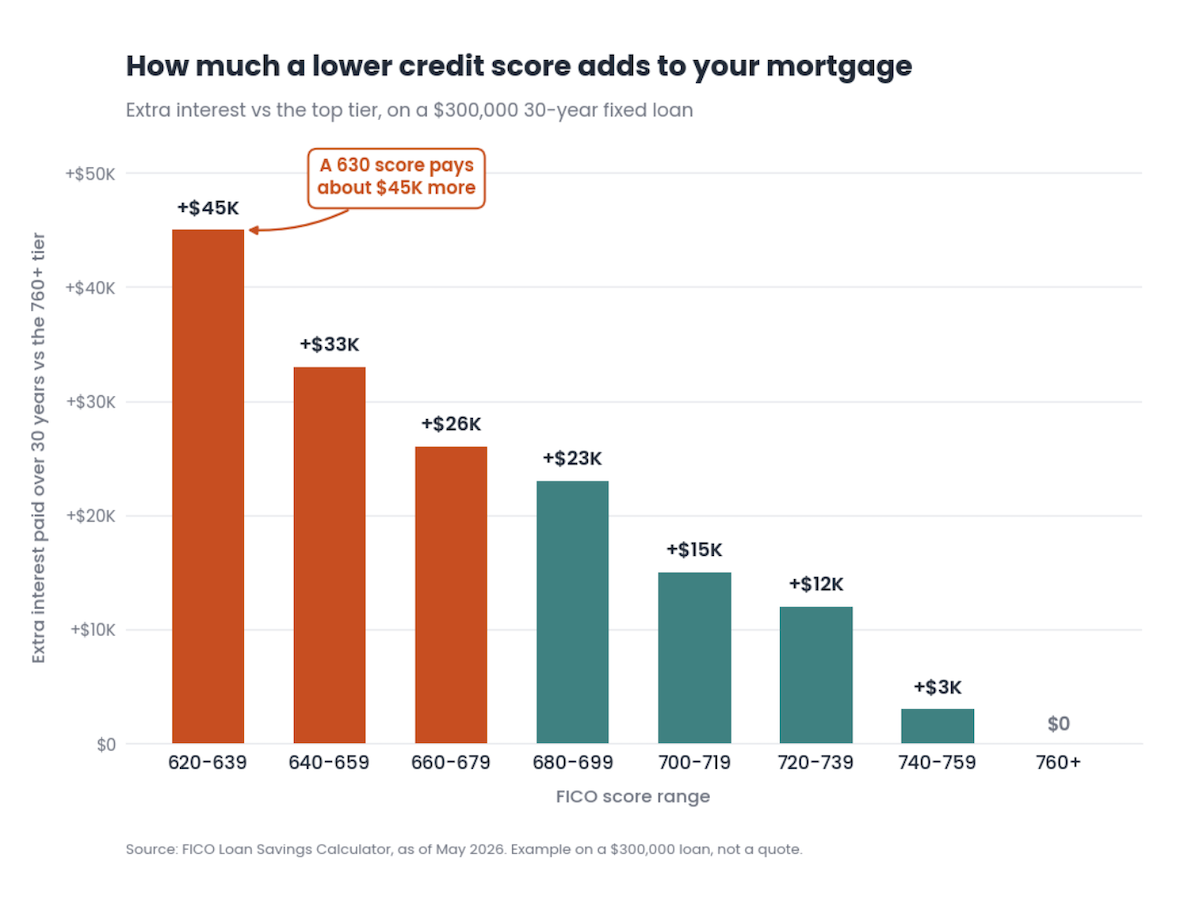
The gap isn’t small. As of July 2, 2026, the average 30-year fixed rate was 6.43% for buyers with strong credit and 20% down (Freddie Mac), and lower scores pay more than that.
FICO’s own Loan Savings Calculator puts it in dollars. On a $300,000 loan, moving up one tier, say from the 640 to 659 range into the 660 to 679 range, can save more than $7,000 in interest over the life of the loan. Moving from the low-600s to the top tier can mean roughly $150 less every month and tens of thousands of dollars less over 30 years. (FICO figures, an example, not a quote for your loan.)
A lower score can also raise the monthly mortgage insurance you pay on a conventional loan when you put down less than 20%.
Approval is only half the picture. The half that costs you money is which tier you land in and how close the next one sits. Get your personalized mortgage credit analysis to find out.
Should you apply now, or wait a little?
If you’re close to the next tier, a short wait can pay off.
Say you’re at 638 and could reach 660 in 30 to 90 days by lowering a card balance and keeping every payment on time. That jump could move you into a lower interest-rate tier and cut your monthly payment for the life of the loan.
Waiting isn’t always the answer. Home prices, rent, and rates all move too. But if a small, realistic gain could drop your rate, it pays to know before you lock in.
The way to decide is to see your actual scores and your exact gap.
Mortgage Readiness Tip
A short wait can pay off. A focused 30 to 90 days spent lowering a balance and paying on time may be enough to reach the next score tier, which could lower your rate before you ever lock it in.
Do first-time buyers really need a 700 or 720?
No, and that belief costs people years of waiting.
Many first-time buyers think they need a 720 before anyone will take them seriously. So they keep renting while home prices and their rent both climb.
The loan programs say otherwise. FHA opens at 580. Conventional works at 620. VA and USDA set no minimum score.

A score in the mid-600s is a real starting point, not a wall. So forget chasing a perfect number. What matters is how far you sit from the next tier that lowers your rate, and how long it takes to get there.
Mortgage Readiness Tip
The score that decides your loan is the middle of your three mortgage-specific scores, not the free number in your credit or banking app. Checking those before you apply is one of the simplest ways to avoid a surprise at the closing table.
What to do if your score is below your target
If your number is short, you have real ways to move it, and none of them require guessing.
- Lower your card balances. Bringing what you owe down compared to your limits is usually the fastest way to see movement.
- Never miss a payment. On-time payments matter more than anything else in your score. One missed payment can wipe out months of progress.
- Don’t open new credit right before you apply. New accounts and credit checks can drop your score at the worst time.
- Give it a real runway. Balance changes can show up in a cycle or two. Recovering from a missed payment takes longer. Year-end is a good time to get your credit in shape, so you’re ready to buy by spring.
No honest service will promise you an exact number or a guaranteed jump, and you should be wary of anyone who does. Good habits move the odds in your favor, which is what lenders reward.
The hard part is knowing which of these moves will do the most for your score, because that depends on what’s actually on your credit report, and it’s different for everyone. A personalized mortgage credit analysis reads your real profile, shows you the exact gap between your score and your target, and points you to the moves that matter most for you. From there, our credit optimization work helps you close that gap and get mortgage-ready, without the guesswork.
Prefer to keep going on your own first? These help:
- If you need to raise your mortgage score, here is how to raise your mortgage FICO score.
- If you’re starting from a thin or rebuilding credit file, learn how to build credit to buy a home.
- Once your score is in range, get your paperwork in order with the mortgage pre-approval checklist.
- Then see if you’re ready to qualify for a mortgage.
Frequently asked questions
See your number and your gap
Program minimums tell you the floor. They don’t tell you your real mortgage score, which of your three numbers a lender will use, or how close you are to the tier that lowers your rate.
A personalized mortgage credit analysis answers all three in a few minutes and gives you a plan. You’ll see your estimated mortgage score range and how many points separate you from the next tier.
How these loans work: the consumer home loans (FHA, VA, Conventional) mentioned here are offered through our licensed partner, Better Mortgage. Tradeline Works provides credit optimization and mortgage readiness services and doesn’t lend the money itself.
About the author. Porsha O’Reilly is Senior Editor for Credit Strategy at Tradeline Works, with 5+ years in credit optimization and mortgage readiness and more than 1,000 clients served. She writes and edits the credit optimization content behind this work.